Martin Companies
Brand Strategy Development
Overview
Martin Companies is a rapidly growing, faith-based home services organization operating across four primary divisions: Appliance, Furniture, Water Conditioning, and HVAC. What began as a trusted, family-owned appliance business has expanded into a multi-division company serving homeowners across Central Pennsylvania and into growth markets.
With that growth came complexity.
Each division had built its own awareness and reputation, yet brand cohesion had not kept pace. Customers often knew Martin for one service, not the full ecosystem. Messaging varied across divisions. Internally, culture was strong—but externally, the unifying story was unclear.
Martin engaged us to develop a comprehensive brand strategy framework that would:
Unite four divisions under one cohesive identity
Clarify its true differentiator in a saturated market
Translate its faith-based mission into a modern, confident brand voice
Increase cross-division awareness and lifetime customer value
Prepare the brand for scalable, long-term growth
The engagement was structured in two phases.
Phase 1: Discovery & Insights focused on uncovering the authentic DNA of Martin Companies through stakeholder interviews, competitive analysis, and an in-person brand work session. The goal was to identify the cultural truths, emotional differentiators, and structural gaps shaping the brand today Martin Companies Phase 1- Disco….
Phase 2: Brand Strategy Development built on those findings to define a unifying brand platform, clarify brand architecture, evolve archetype positioning, codify voice and messaging, and deliver a strategic roadmap for implementation across all divisions.
Phase 1 revealed who Martin truly is.
Phase 2 defined how that truth should show up in the world.
The sections below outline the full journey—from discovery to strategic direction.
Goals
Based on stakeholder conversations, briefing materials, and leadership alignment sessions Donovan Client Input Brief the core goals of the engagement were:
Unify the Brand Across Divisions: Create a clear brand architecture that connects Appliance, Furniture, Water Conditioning, and HVAC under one recognizable Martin identity—without diluting divisional expertise.
Define and Codify the True Differentiator: Move beyond generic category language like “affordable, local, dependable” and articulate what Martin uniquely owns in the marketplace.
Translate Culture into Strategy: Martin’s internal culture—grounded in faith, humility, and servant leadership—was widely admired. The goal was to translate that lived culture into a confident, modern brand platform.
Increase Cross-Division Awareness: Shift customers from single-division relationships to full “lifetime customer” engagement across services.
Prepare the Brand for Scalable Growth: Build a strategic roadmap that supports geographic expansion and modernization without compromising Martin’s relational DNA.
Challenges
Category Saturation & “Sea of Sameness”: Competitive analysis revealed that nearly every competitor across Appliance, HVAC, Water, and Furniture claimed to be family-owned, trustworthy, reliable, and customer-focused. These values had become table stakes, not differentiators Martin Companies Phase 1- Disco…. The industry was dominated by flyer-style promotions, price messaging, and transactional communication.
Internal Humility as Both Strength and Limitation: Martin’s culture emphasized humility and servant leadership. While this built deep trust, it also muted the brand’s external voice. Leadership was cautious about appearing promotional or boastful.The strategic challenge: express confidence without sacrificing humility.
Brand Fragmentation: Customers often associated Martin primarily with appliances. Awareness of Water, HVAC, and Furniture lagged significantly. Internal teams also lacked consistent cross-division fluency. The organization was unified culturally—but not structurally or narratively.
Broad Target Definition” The initial audience definition skewed “everyone”—homeowners 30–70+ across multiple counties. Refining focus without excluding core customers required strategic nuance.

Phase 1: Discovery & Strategic Foundation
Phase 1 was designed to surface authentic truths—not assumptions—about Martin Companies. The process included:
7 qualitative stakeholder interviews
A detailed cross-division competitive analysis
A half-day in-person brand discovery workshop with leadership
Synthesis into a formal Executive Summary and Key Insights document
Part #1: Stakeholder Interviews
In the project’s initial stages, I conducted seven qualitative interviews across a cross-section of stakeholders:
Employees
Family Members
Consultants
Customers
Distributor Partners
Each interview explored brand differentiation, trust, culture, faith expression, cross-division awareness, and future growth vision.
What We Discovered
Culture Is the True Differentiator
Every interview—internal and external—pointed to integrity, humility, and servant leadership as Martin’s competitive edge. Products and pricing mattered. Culture mattered more.Trust Is Earned Through Behavior
Stakeholders described small but meaningful actions—protecting floors, cleaning behind installs, telling the truth even when it cost a sale. Trust was operational, not aspirational.Faith Shows Up Through Action, Not Marketing
Martin’s Christian foundation shaped behavior and stewardship—but it was never experienced as performative or exclusionary.Awareness Lags Reputation
Customers who knew Martin were fiercely loyal. Most only knew one division. The “One Martin” story existed internally—but was invisible externally.
This insight became pivotal: the issue wasn’t brand weakness—it was brand articulation.
Part #2: Competitive Analysis
We analyzed competitors across all four divisions, including regional appliance retailers, HVAC companies, water conditioning providers, and furniture brands.
Key Findings
A Sea of Sameness
Nearly every competitor claimed trust, family ownership, and quality. Messaging was repetitive and interchangeable.Transactional Over Relational
Most competitors relied on price-driven promotions, flyer-style websites, and product-first messaging. Few brands owned emotional territory.No Cohesive Brand Backbone
Competitors lacked a unifying belief system or organizing narrative. Story was missing. Culture was often claimed—but not demonstrated.Strategic White Space
The opportunity was clear: own emotional territory around principled care and whole-home stewardship—rather than competing on function or price.
Part #3: In-Person Brand Discovery Work Session
A half-day facilitated workshop brought Martin leadership together to explore brand identity, differentiation, architecture, and voice.
Exercises Included:
Brand archetype exploration
“What’s working/what’s missing” brand audit
Brand personality selection exercises
Brand architecture scenario planning (Branded House vs. Endorsed Brand vs. House of Brands)
Emotional promise development
What Emerged
Remarkable Internal Alignment
Across independent exercises, leadership consistently selected similar personality traits: trustworthy, dependable, caring, humbleShift from Everyman to Caregiver
While Martin historically operated in “Everyman” territory (approachable, community-based), the deeper truth aligned with the Caregiver archetype—service as stewardship, care as competitive advantageThe Language of Home
The conversation moved from products to feelings: Comfort. Peace of mind. Confidence. Connection.
This emotional convergence became the foundation for Phase 2 positioning exploration.
Phase 1 Outcome
Phase 1 did not invent a new brand.
It revealed the one already there.
The synthesis document articulated:
Culture as competitive advantage
Trust as operational behavior
Faith as stewardship, not slogan
Brand fragmentation as the primary growth barrier
Emotional white space in a transactional category
The work culminated in a strategic recommendation to evolve Martin from an “Everyman” archetype to a clearly articulated Caregiver platform—anchored in principled service and whole-home stewardship.
Phase 2: Brand Positioning & Platform Development
If Phase 1 revealed the truth about Martin, Phase 2 defined how that truth should live in the market.
Building on discovery insights, Phase 2 formalized three major strategic moves:
A brand name evolution from Martin Companies to Martin Home
An archetype shift from Everyman to Caregiver
Two fully developed strategic positioning directions rooted in Caregiver
The outcome was not cosmetic. It was structural, emotional, and strategic.
Brand Name Evolution: From Martin Companies to Martin Home
Phase 1 surfaced a powerful insight: consumers don’t experience Martin as a “company.” They experience it as part of their home life.
“Companies” feels internal, corporate, organizational.
“Home” feels personal, emotional, lived-in.
Consumers don’t think in business units. They think in home ecosystems.
HVAC. Water treatment. Appliances. Furniture.
To the customer, these are not separate categories — they are components of one connected home experience.
The recommendation to evolve the name to Martin Home reframed the brand:
From a collection of divisions
To a unified presence in the home
Strategically, this shift:
Increased emotional relevance
Reduced corporate distance
Strengthened cross-division cohesion
Positioned Martin as a long-term partner, not a vendor
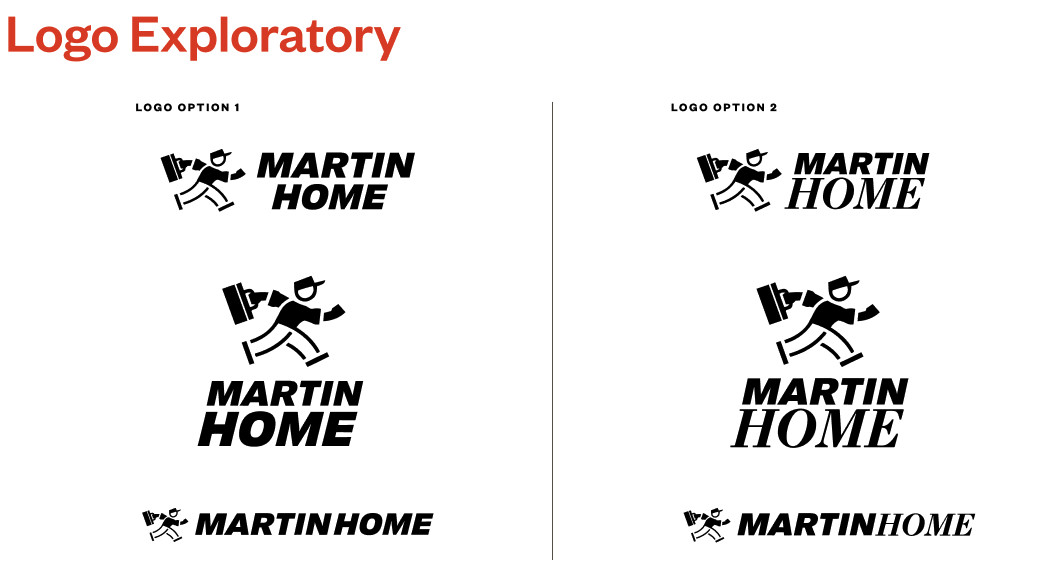
Logo exploratory concepts were developed to reflect this evolution, reinforcing the shift visually as well as verbally.
Archetype Evolution: From Everyman to Caregiver
Phase 1 confirmed that Martin historically operateed within the Everyman archetype—approachable, familiar, dependable.
The problem: that territory is crowded and indistinct in this category.
Phase 2 reframed Martin’s identity around the Caregiver archetype—owning the emotional territory of:
Home
Care
Stewardship
Being looked after
This evolution was not a reinvention. It was an articulation of what already existed culturally.
The Caregiver platform elevated Martin from: “Friendly and local” to “Principled, steady, and essential to home life.”
From that foundation, we developed two strategic expressions of Caregiver—each paired with a distinct secondary archetype.
Strategic Direction #1: “Decisions You Can Stand Behind”
(Caregiver Primary + Sage Secondary)
This direction centers on reducing anxiety around major home investments.
The insight: homeowners don’t need drama. They need steadiness.
Rather than amplifying urgency, Martin’s role becomes neutralizing uncertainty — helping customers feel certain, relieved, confident, and proud long after the purchase.
Consumer Tension: Choices You’ll Live With | Brand Payoff: No-Regret Outcomes
Positioning Statement: Martin supports life at home with integrity, skill, and care, helping people make confident decisions where it matters most.
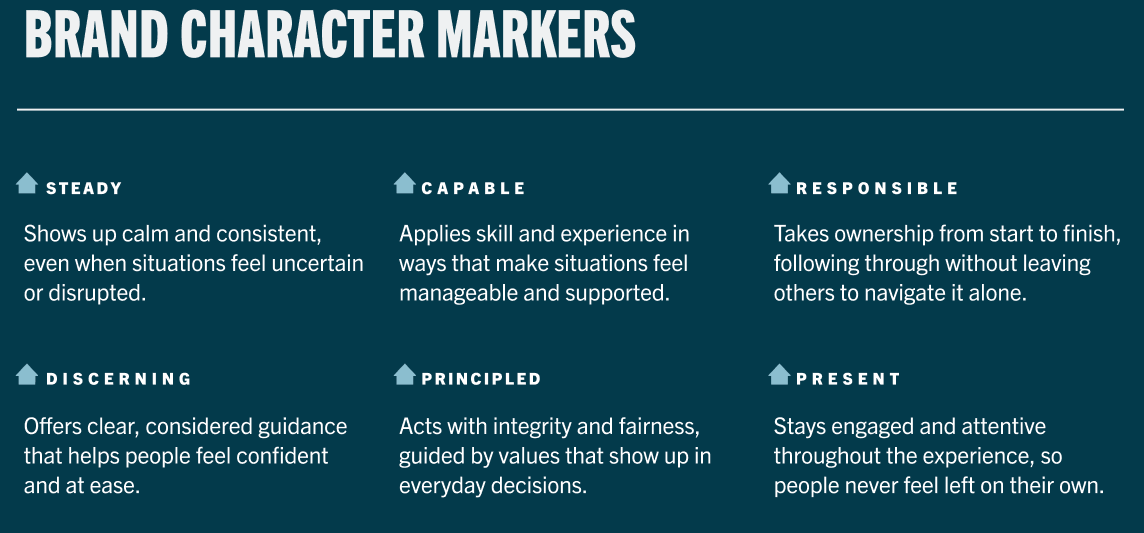
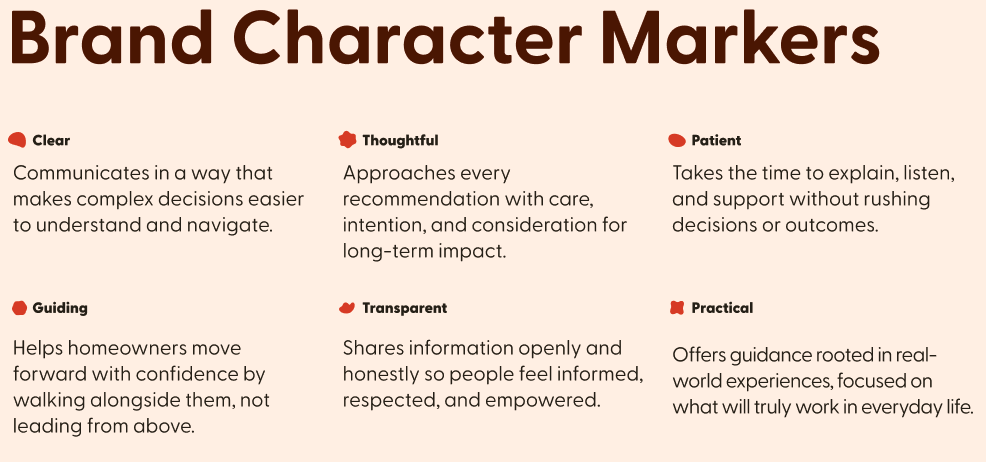
Brand Character Markers:
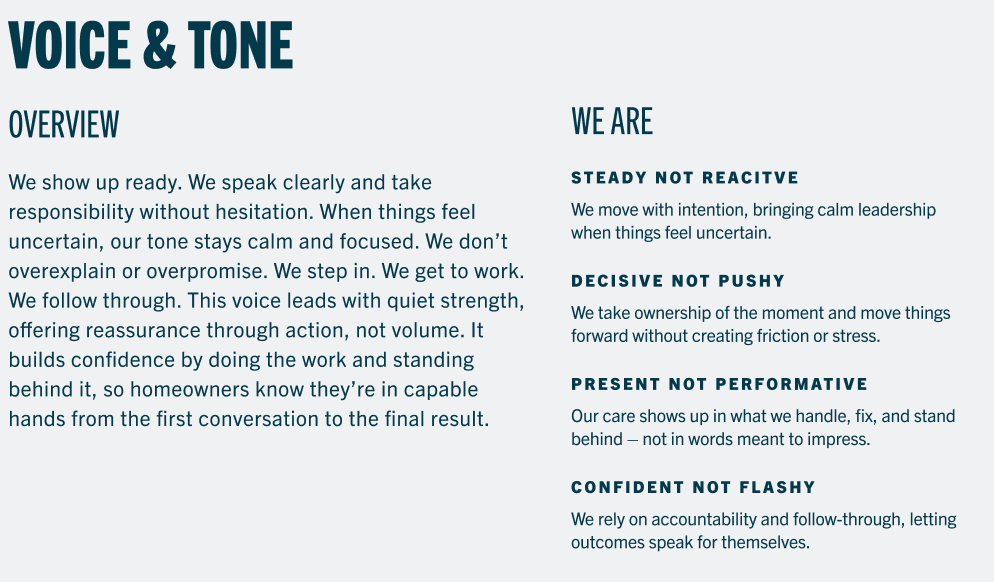
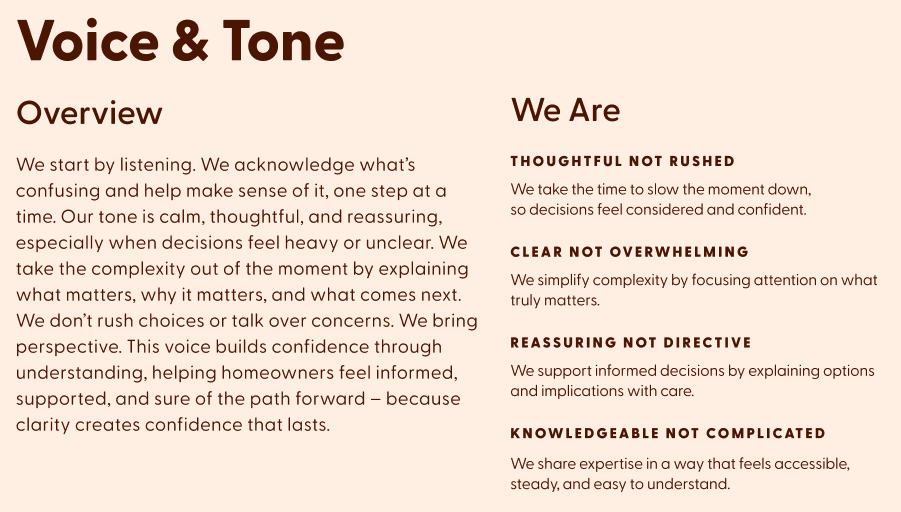
Voice & Tone Guidance:
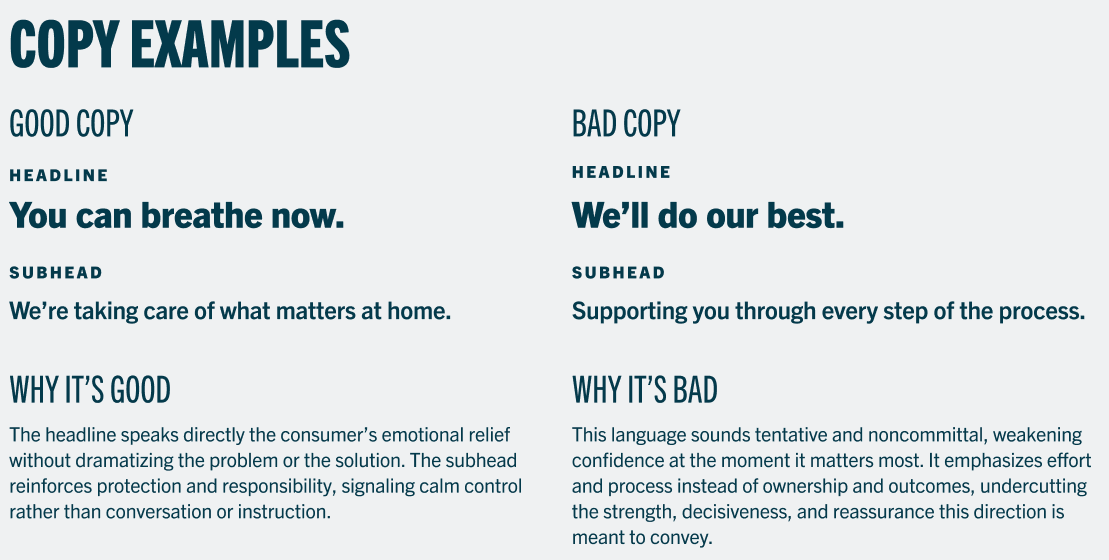
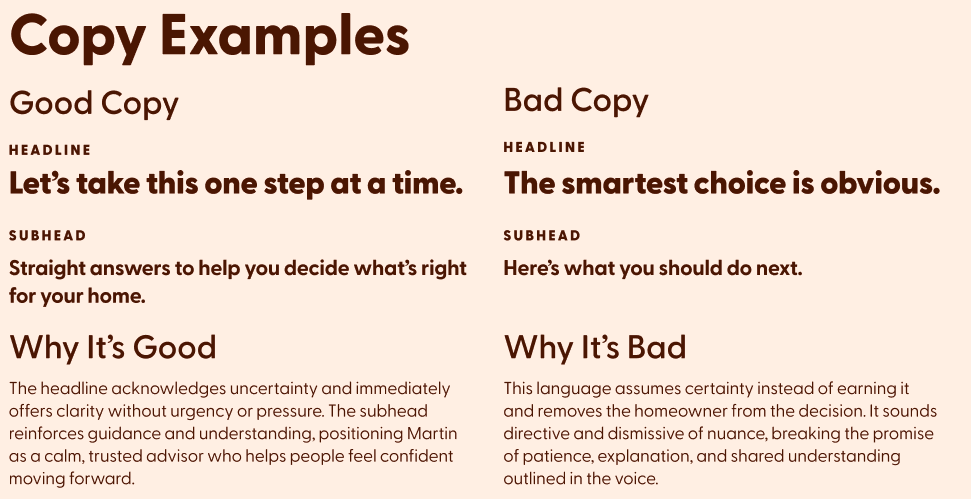
Copy Examples:
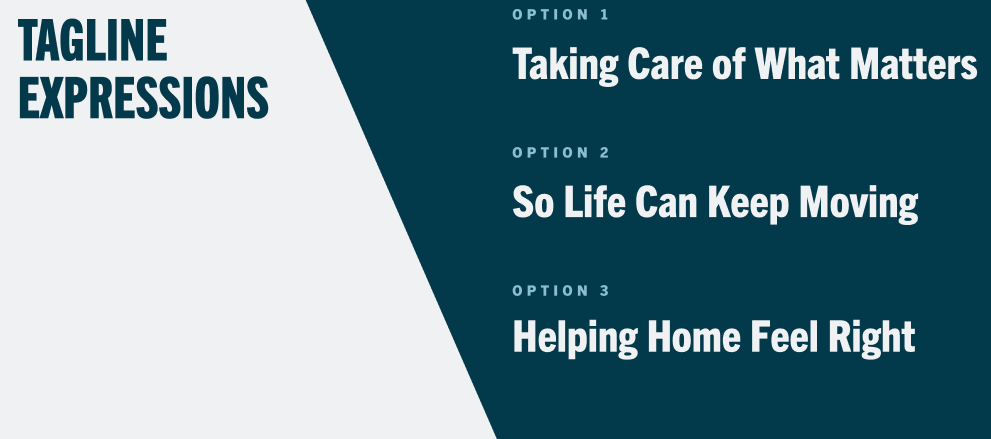
Tagline Expressions:
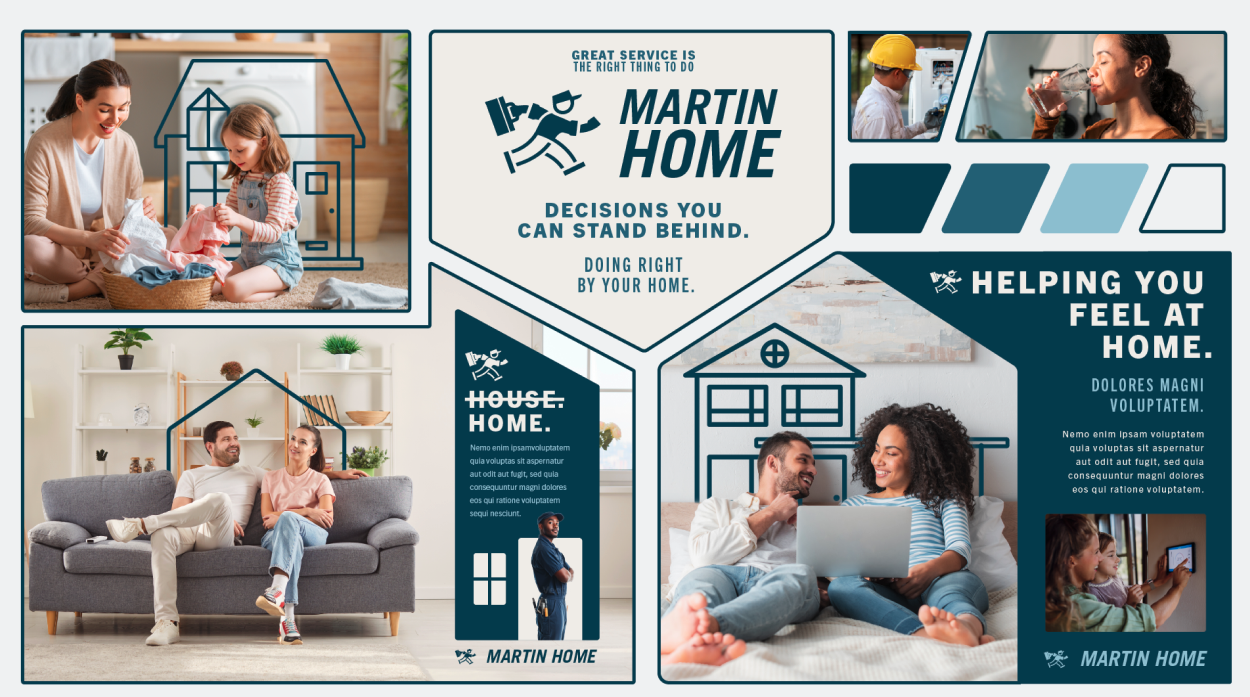
Direction #1 Mood Board
This design system reinforces calm confidence:
Limited, timeless color palette
Structured framing devices suggesting stability and security
Proud, confident homeowners
Interlocking graphic elements representing capability and precision
This direction positions Martin Home as the steady hand when stakes feel high.
Strategic Direction #2: “Guided With Care”
(Caregiver Primary + Sage Secondary)
Where Direction #1 emphasizes reassurance after decisions, Direction #2 emphasizes clarity before decisions.
The insight: the category overwhelms consumers with options but offers little guidance.
Martin’s differentiator becomes structured clarity.
Consumer Tension: Information Fatigue | Brand Payoff: Clarity You Can Trust
Positioning Statement: Martin serves as a trusted guide for the home, helping homeowners make clear, confident decisions through every stage of home life.
Brand Character Markers:
Voice & Tone Guidance:
Copy Examples:
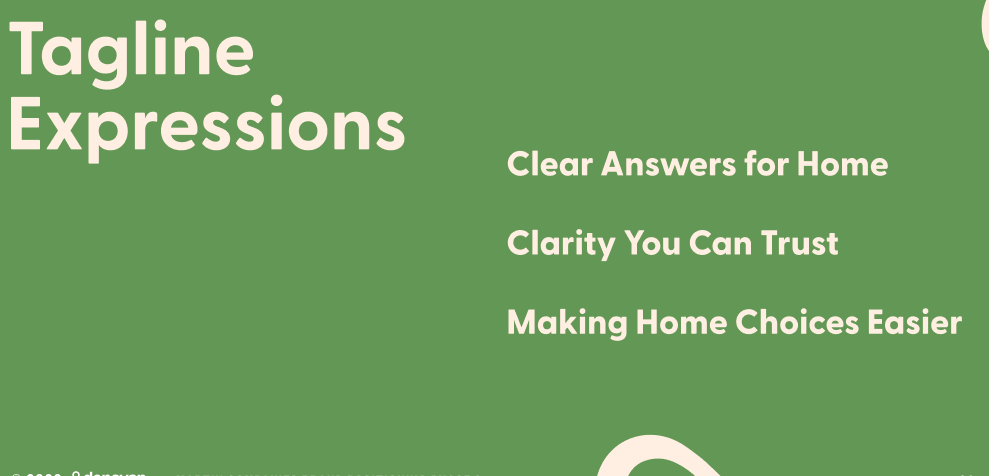
Tagline Expressions:
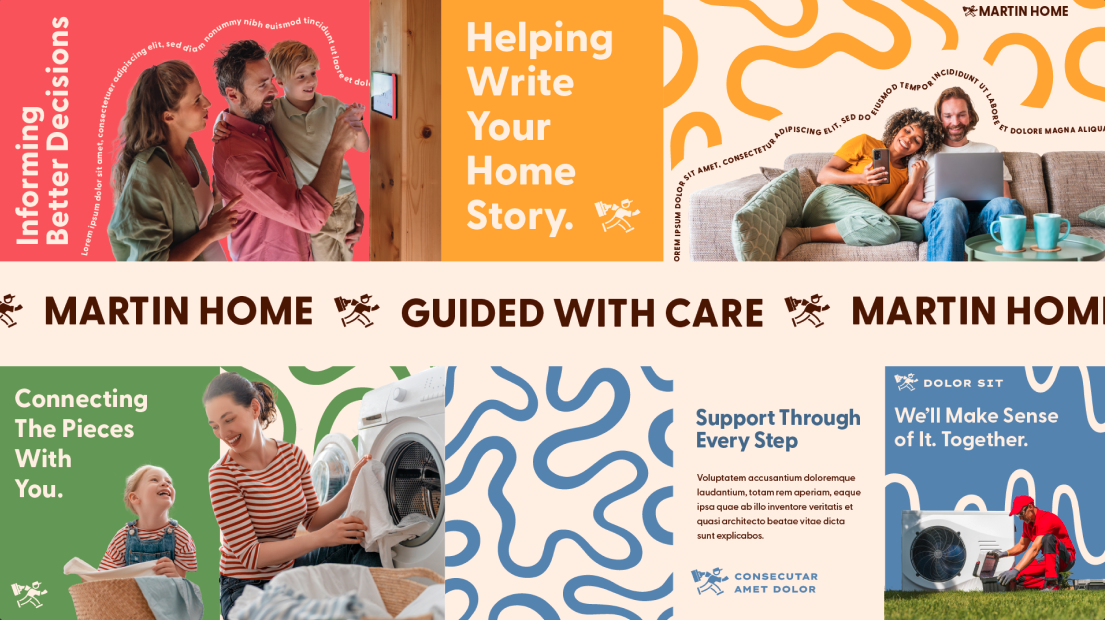
Direction #2 Mood Board
This direction leans into organic guidance:
Flowing line systems representing navigation paths
Friendly, warm palette tied to divisions
Typography that feels approachable and educational
Photography centered on families benefiting from informed decisions
Where Direction #1 expresses strength through steadiness, Direction #2 expresses care through clarity.
Why Two Directions?
Rather than force a premature decision, Phase 2 presented leadership with two fully realized, executable brand territories.
Each:
Rooted in Caregiver
Aligned with Martin’s lived culture
Visually and verbally systemized
Built to scale across all four divisions
Designed to support the new Martin Home identity
The decision was not about right vs. wrong. It was about emphasis: reassurance vs. guidance.
Both territories move Martin beyond transactional competitors and into emotional white space.
Deliverable: Brand Positioning Roadmap
Phase 2 culminated in a comprehensive Brand Positioning presentation, including:
Brand name evolution rationale
Logo exploratory directions
Archetype strategy
Two fully developed positioning platforms
Messaging and voice frameworks
Visual identity rationale
Social and content application guidance
This created a scalable foundation for:
Brand guideline development
Marketing modernization
Cross-division cohesion
Future creative rollout
Results (to be updated)
Formal leadership response and implementation decisions will determine next steps, including:
Final name adoption
Platform selection
Brand guideline development
Rollout strategy
This section will be updated following official adoption and activation.